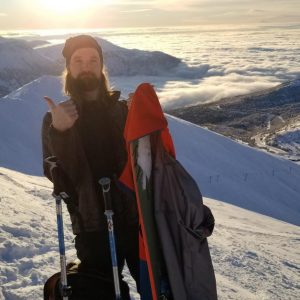
Matt Cullin builds life of growth and success out of expertise in corrosion and failure analysis

Volunteer Spotlight

Cullin is a member of the Terminal Operations and Environmental Monitoring Committee. Volunteers like Cullin dedicate their time and expertise on committees who advise the Council’s Board of Directors on technical issues related to the safe transportation of oil through Prince William Sound.

At his job as the director of the University of Alaska Anchorage’s BP Asset Integrity and Corrosion Lab, Matt Cullin imagines himself as a detective.

“I do a lot of failure analysis work for the oil and gas industry,” he says. “Basically when stuff breaks, we do the CSI forensics to figure out why things broke and why they failed.”

They get big projects and a lot of smaller failures too. “Every couple of months somebody shows up with an old piece of pipe and asks us to tell them what happened.”

His goal isn’t just to solve the crime, though, he wants to learn how to prevent corrosion. For all of these projects, Cullin says his next question is always “how can you keep it from failing in the first place?”

Volunteering for the Council

Cullin also puts his background in mechanical engineering with a specialty in corrosion, materials, and failure analysis into use for the Council as a member of the Terminal Operations and Environmental Monitoring, or TOEM, Committee. He says working with the committee helps him better understand the pipeline and terminal. The students in his classes at UAA benefit too.

“Students have a lot of questions about the pipeline and the terminal,” Cullin says. “These are engineers who might go to work for the state or Alyeska and for them to have that information before they graduate is pretty neat. It’s not a given, when you get a university degree, that you’ll get to study this applied information that’s relevant to your local installation.”

“It’s a cool symbiotic relationship,” he adds.
Read more

From Alyeska: “A journey, never a job.”

Submitted by Alyeska. This profile is from their Memories & Mileposts story collection which commemorates 45 years of TAPS operations.  After helping build the Trans Alaska Pipeline, or TAPS, from 1974-1977, operating rock trucks, fuel trucks, boom trucks, and forklifts, including working on a Hercules aircraft team offloading critical supplies while Wein F-27s were hauling workers … Read more

Schantz: The value of learning from history and experience

Photo of Donna Schantz
Donna Schantz

By Donna Schantz
Executive Director

After the 1989 Exxon Valdez oil spill, many of the people impacted used lessons learned to advocate for safeguards to ensure a spill like that never happens again. Thanks to the foresight, vigilance, and tireless efforts of these elected officials, government regulators, industry, and citizens, Prince William Sound is now recognized as having a world-class oil spill prevention and response system for the Valdez Marine Terminal and associated oil tankers. The biggest successes achieved in our region have been a result of these partners working together toward the common goal of moving oil safely.

Congress found that complacency on the part of industry and government was a major contributing factor to the Exxon Valdez spill. To combat this complacency, Congress established two regional citizens advisory councils, one in Prince William Sound and another in Cook Inlet. Neither council could satisfy the provisions under this federal mandate without dedicated volunteers from throughout their respective regions. Citizen oversight brings irreplaceable local knowledge and expertise to the table, and involves those with the most to lose from oil pollution in the decisions that can put their livelihoods, resources, and communities at risk. Since our formation, our work has helped bring about some changes and advancements that would not have happened had we not been in existence.

Read more

Skip to content