On board most commercial shipping vessels, captains, crews, and local pilots hail from across the world. The use of multiple languages means communicating important information can be difficult. New research may be able to help.
Since the 1970s, the shipping industry has made efforts to develop a simplified common language that would allow crew members to communicate.
The earliest of these was a standard vocabulary that began as a set of words and phrases related to navigation, weather, and other common topics specific to vessel operations.
Over the years, this simplified language, referred to as “maritime English,” was revised and expanded to include “message markers.” These markers, such as “instruction,” “question,” or “warning,” gave the listener clues about the speaker’s intentions, and what the listener was expected to do with the information.
Problems linger
Despite these efforts to improve, investigations into marine accidents have shown that miscommunication still contributes to many incidents. A multi-year series of Council-sponsored reports dives into this lingering problem.
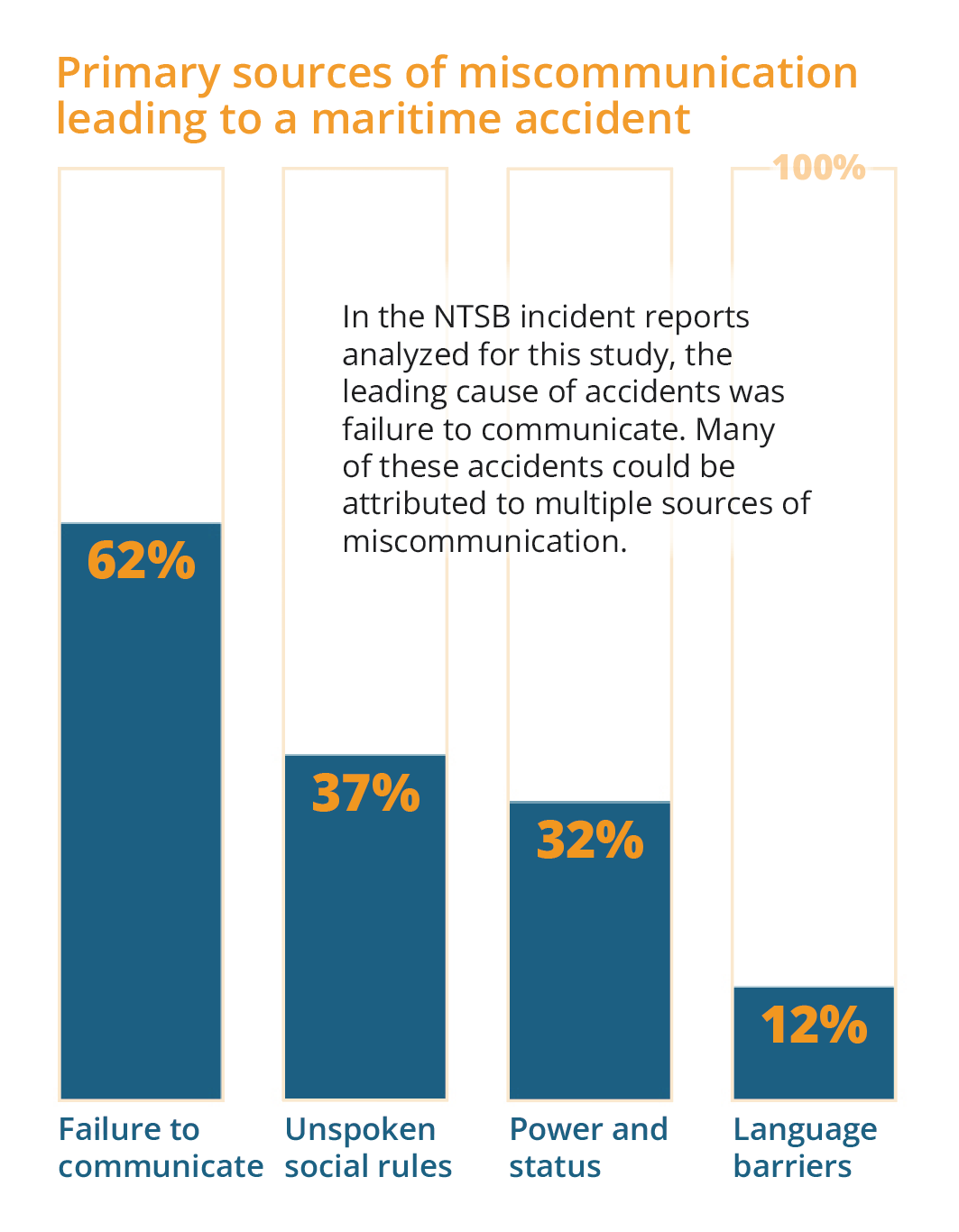 Researcher Dr. Nicole Ziegler reviewed existing studies, analyzed incident reports from the National Transportation Safety Board where miscommunication was listed as a potential factor and interviewed maritime experts. She collected data to determine the most common problems among the incidents she reviewed.
Roots of miscommunication
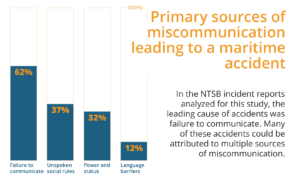
Failure to communicate: In 62% of the accident reports analyzed by Dr. Ziegler, mariners did not communicate about their own plans, or they made an assumption about someone else’s plans without confirming. In the report, Ziegler used the example of two vessels, the St. Louis Express and the Hammersmith Bridge, that collided on a river in Belgium in 2015. The local Belgian pilot did not tell the American crew of the St. Louis Express about plans to safely pass the Hammersmith Bridge, and the American crew assumed the pilot was aware of the vessel heading towards the St. Louis Express.
Unspoken social rules and norms: Politeness and “saving face” are two social rules that contributed to 37% of the incidents examined in the study. Ziegler noted in the report that some cultures struggle with requesting clarification or requesting orders be repeated. Politeness strategies such as being indirect can cause confusion. An example Ziegler gave was the vessel American Liberty, which ran into several moored vessels on the Mississippi River in 2019. The pilot’s request to the vessel’s captain to “give me whatever you can give me cap” did not clearly convey the urgency of the situation, and led to a mismatch of intentions.
Power and status: Communications between different ranks was a factor in 32% of the incidents reviewed by Dr. Ziegler. Higher ranked crew sometimes disregard information from a lower-ranking mariner. Lower-ranked crew sometimes avoid contradicting someone in a higher rank.
Language barriers: Even when non-English speakers are trained in maritime English, communication failures occurred in 12% of the accident reports examined. Ziegler found several issues in this category:
- English speakers need training too. Mariners whose first language is English are not always trained to use the standard phrases and methods of maritime English.
- Spoken words unclear. Studies found that some native English speakers spoke too fast or did not enunciate clearly enough to be easily understood by non-native speakers.
- Teaching methods inconsistent. Ziegler found that classes for non-native speakers did not always provide enough practice in speaking and listening to fully develop skills.
Improving training
Dr. Ziegler currently has plans to develop a curriculum based on these findings, which she hopes will begin to address some of the problems. Two top issues she identified for improvement are:
- Exchanges between the captain and the pilot.
- Allowing time for crew members to practice questioning and disagreeing with someone of a higher rank.