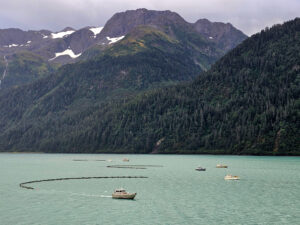
Hundreds of fishing vessels will remain a vital part of Alyeska’s oil spill response program, thanks to the passage of the FY2026 National Defense Authorization Act, or NDAA. The bill was signed into law on December 18, 2025.
The language that preserves this important aspect of oil spill prevention and response in Alaska can be found in the Coast Guard Authorization Act of 2025, contained within the NDAA, in Division G, Section 7406, “Additional Response Assets.”
The participation of local vessels in the program was potentially jeopardized when language, which proved to be subject to inconsistent interpretation, was inserted into the 2023 National Defense Authorization Act, directing the U.S. Coast Guard to address the use of certain vessels that tow boom and other equipment in support of oil spill response. This led to a policy requiring these vessels to be inspected. As a result, many of the vessels would have been required to pass inspections that they were not specifically designed for.
The Council has been participating in a workgroup that helped develop the solution to this pressing issue. Other workgroup members included Alyeska Pipeline Service Company, Cook Inlet Regional Citizens Advisory Council, Washington State Maritime Cooperative, Alaska Chadux Network, the American Waterways Operators, Cook Inlet Spill Prevention & Response, Inc. (CISPRI) and Southeast Alaska Petroleum Response Organization (SEAPRO).
Alaska Senators Lisa Murkowski and Dan Sullivan, and Representative Nick Begich supported and introduced the change to Congress.
“This is the culmination of years of work and coordination with the Alaska Congressional Delegation, U.S. Coast Guard, industry, and other partners on the workgroup,” said Donna Schantz, executive director for the Council. “It is a huge success for our organization, and the Prince William Sound spill prevention and response system as a whole.”
Senators Lisa Murkowski and Dan Sullivan both highlighted the news in media releases on the new NDAA: Murkowski statement | Sullivan statement
Alyeska Pipeline Service Company’s Ship Escort Response Vessel System (SERVS) contracted fishing vessel program is commonly held up as a model around the world for its response capabilities. As mentioned above, these contracted fishing vessels are known and referred to nationally as VOOs.
Following the passage of the 2023 NDAA, the Coast Guard implemented a policy requiring additional inspection requirements for VOOs participating in exercises, trainings, and actual responses to oil spills. If an exemption was not enacted to this, the directives in the policy would have completely dismantled the SERVS contracted fishing vessel program for the entire Exxon Valdez oil spill region, greatly diminishing oil spill response capabilities in Alaska.
The vessels contracted to SERVS are either uninspected, or are inspected as required for their regular use, and were designed and built specifically for fishing, or other purposes, not oil spill response. Many would not be able to meet additional inspection requirements imposed under the Coast Guard’s policy, meaning they would be excluded from participating in a response. The exemption that provided the solution to this issue, which passed in the 2026 NDAA, used the term “qualified vessel,” instead of VOO.
The backbone of oil spill response in Prince William Sound
When the Exxon Valdez oil spill happened in 1989, the response was delayed. Much of the damage could have been lessened if clean-up efforts had started immediately. One of the most important lessons from that devastatingly destructive oil spill was that local fishing crews were able to help with a quick response.
The local fishing crews who joined the 1989 response realized that pulling oil spill boom was similar to pulling a net of fish. They also knew the region’s waters well and were aware of dangers like shallow areas or changing tides that could leave a vessel stranded, among other hazards.
The Oil Pollution Act of 1990, enacted largely in response to the Exxon Valdez oil spill, includes a provision that requires response plans for tank vessels operating in Prince William Sound, or a facility permitted under the Trans Alaska Pipeline Authorization Act to provide for “(3) training in oil removal techniques for local residents and individuals engaged in the cultivation or production of fish or fish products in Prince William Sound;” and “(4) practice exercises not less than 2 times per year which test the capacity of the equipment and personnel required under this paragraph.”
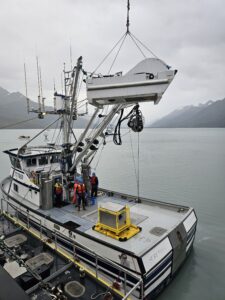
In the years since the spill, Alyeska Pipeline Service Company formalized this relationship, developing a program to make sure they have a contracted fleet of vessels that are trained, on-call, and immediately available to support a response in case of another major oil spill. Today, Alyeska holds contracts with approximately 350 of these vessels. They invest in training for crew members every year to make sure they are always ready to respond.
Alyeska trains the crews, under SERVS, to handle oil spill response equipment, tow oil spill boom in proper formation, and tow the small barges used to store the oil and water mix that is recovered during an oil spill response. They are skilled in deploying, operating, and maintaining this equipment. If another real event were to occur, Alaska’s fishing crews are ready to respond.
The Council is proud of our participation in the workgroup that helped preserve this world-class program. This effort is a prime example of the work done by both regional citizens advisory councils to fulfil our mandates to foster partnership and cooperation among local citizens, industry, and government; build trust; and provide citizen oversight of the oil industry in our regions.