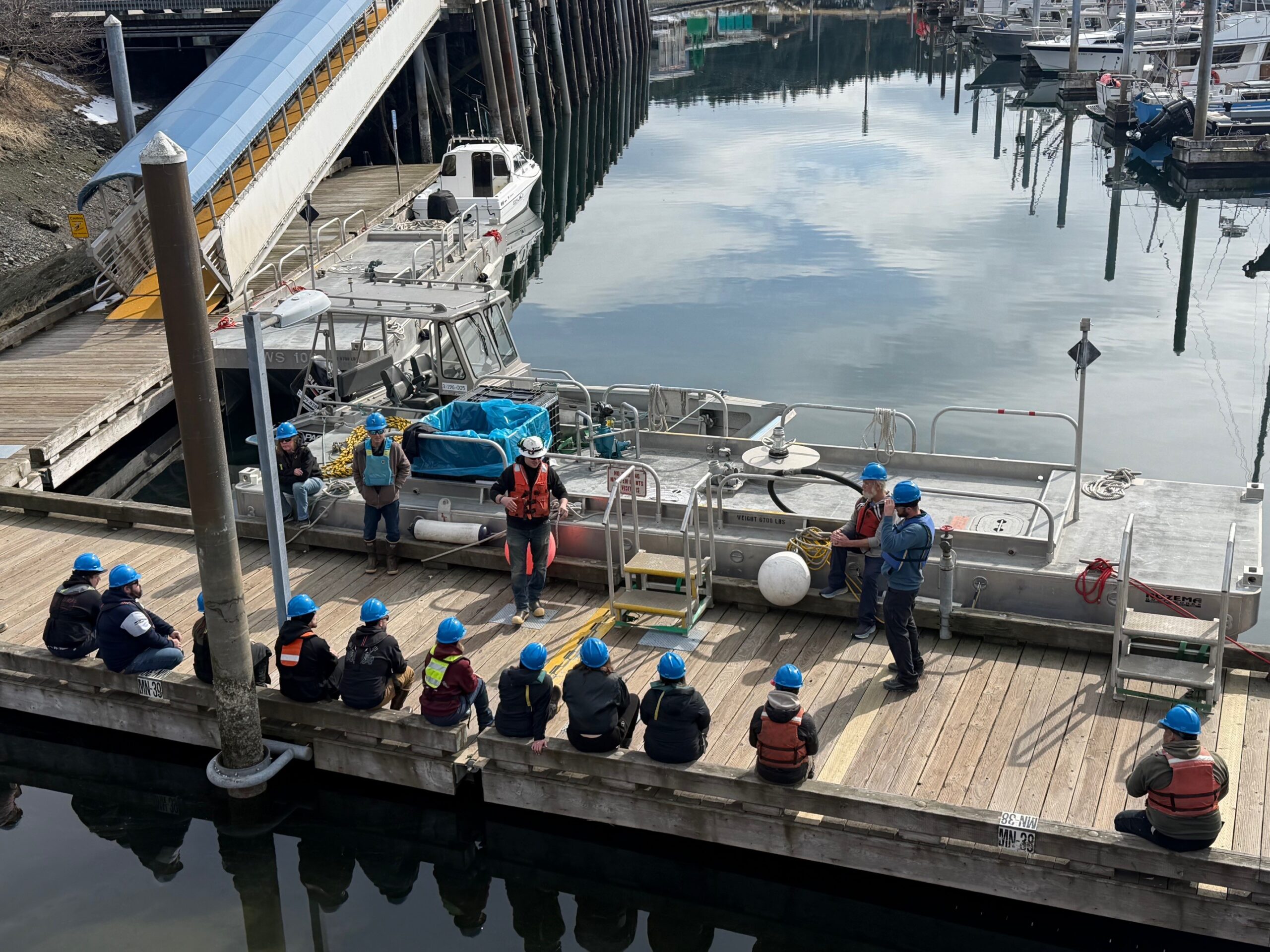
The Council held walking tours for locals to learn about the annual oil spill response training for fishing vessels in Kodiak, Alaska, on April 6 and 7, 2026. This has been a regular event since 2016, rotating through communities in the Exxon Valdez oil spill region. The Kodiak community was invited to join the Council on one of several tours to observe how local vessel operators are trained to use the oil spill response equipment. Over 40 members of the public came out to the event, including students from the Kodiak High School and Kodiak College.
The local fishermen and women participating in the training are contracted by the Ship Escort Response Vessel System, also known as SERVS, to respond in the event of an oil spill from a tanker transiting through the Gulf of Alaska and Prince William Sound. SERVS is Alyeska Pipeline Service Company’s oil spill removal organization and coordinates annual spill response exercises in multiple Southcentral Alaska communities, including Kodiak.
This Council event helps keep communities informed on what oil spill prevention and response measures are in place in Prince William Sound and downstream communities, especially those involving their local fishers. Kodiak residents learned about oil spill response technology, tactics, safety and the role of local vessels in protecting regional resources. Narrators from both the Council and Alyeska were on hand to describe the activities so that participants could better understand the training. We would like to thank our partners, Alyeska/SERVS and Kodiak National Wildlife Refuge Visitors Center, for helping to support this event.
”I was definitely interested in increasing my knowledge of what could happen on the Island and anything I can do to help prevent something happening to our environment,” noted attendee Alicia Flores. “Having local people involved is important we this is where we live – where we enjoy fishing and recreational activities. We want to keep this for future generations; to keep it as it was before we got here.”
Alyeska’s contracted fishing fleet is the backbone of their world-class oil spill response system. These local vessels and their crews help ensure the most comprehensive oil spill response measures are in place to protect both open water and nearshore resources. A major lesson of the Exxon Valdez oil spill was that incorporating local mariners into the spill response system helps ensure a quick, efficient and effective response.
Since the inception of SERVS after the Exxon Valdez spill, the Council has been highly supportive of annual oil spill response training for local fishers and mariners. Kodiak mariners have the most intimate knowledge of, and connection to, the waters in and around Kodiak. Their involvement will help protect the most sensitive areas, such as hatcheries and spawning streams, from spilled oil.
“I had heard of the SERVS program, but I didn’t know what it was or what it meant,” said Celeste Ossowki. “I didn’t realize there are so many people in Kodiak that are part of it. It’s great to learn about what our people are doing and how you can get involved.”
The Council has held previous fishing vessel oil spill response training tours in Cordova, Homer, Seward, Valdez and Whittier. The Council conducts programs like this to help communities understand the importance of oil spill prevention and advocating for the most robust response strategies ahead of a spill.