Board Resolution 19-03: Safeguarding Alaska’s Oil Spill Prevention and Response Standards

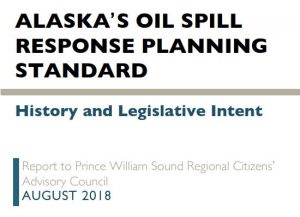
Cover of report titled "Alaska's Oil Spill Response Planning Standard - History and Legislative Intent
To find out more about the history and legislative intent of Alaska’s strong Response Planning Standards, read the Council’s August 2018 report: Alaska’s Oil Spill Response Planning Standard – History and Legislative Intent (Council report/PDF)

The Prince William Sound Regional Citizens’ Advisory Council passed Resolution 19-03 on October 29, 2019: Safeguarding Alaska’s Oil Spill Prevention and Response Standards

WHEREAS, after the 1989 Exxon Valdez oil spill, Congress found that complacency on the part of industry and regulators played a role in the spill, the public trust was broken, and one way to combat this complacency and rebuild trust was to involve the public, those with the most to lose in the event of a large spill, in decisions that affect the safe transportation of oil;

WHEREAS, Congress enacted the Oil Pollution Act of 1990 that included, among other things, the creation of citizen advisory councils for Cook Inlet and Prince William Sound;

WHEREAS, after the Exxon Valdez oil spill, Alaska citizens and the Alaska Legislature worked together to protect the state from major oil spills by enacting comprehensive laws and regulations (Council report/PDF) dealing with prevention, response, contingency planning, financial responsibility, oversight, monitoring, and other subjects related to the safe handling and transportation of oil and other hazardous substances;

WHEREAS, these laws and regulations were based on real world experiences and the painful lessons of the Exxon Valdez oil spill and were crafted in coordination with State government and oil industry partners, requiring extensive compromise in the determined Response Planning Standards ;

Read more

Long-term monitoring in Prince William Sound shows lowest contamination levels in study’s history

Results from the Council’s efforts to monitor the long-term environmental impacts of the operation of Alyeska Pipeline Service Company’s Valdez Marine Terminal and associated tankers since the Exxon Valdez oil spill have shown oil contamination in Prince William Sound and the Gulf of Alaska has reached all-time low values. The Council has been conducting environmental monitoring since 1993.

Alyeska and its owner companies have implemented several improvements over the years which have contributed to the reduction of pollutants being discharged. These include the elimination of single-hulled tankers and Alyeska’s ability to effectively operate their Ballast Water Treatment Facility which removes oil contamination from tanker ballast water.

Read more

Strong regulations are a result of hard lessons

Donna Schantz

By Donna Schantz
Executive Director

The oil spill prevention and response system created for the Valdez Marine Terminal and associated tankers after the 1989 Exxon Valdez oil spill is one of the best in the world. Alyeska Pipeline Service Company and the Trans Alaska Pipeline System tanker operators have worked with regulators and citizens to continuously improve the system over the years. Industry safety records, coupled with the lack of significant spills in the past 30 years, point to the success of industry working within the current system. Credit is also due to the foresight of Congress for enacting the Oil Pollution Act of 1990, which included the creation of the citizen councils, and to the State of Alaska for implementing strong statutes and regulations. The Joint Pipeline Office was created in 1990 to coordinate efforts of the 13 different state and federal regulatory agencies with oversight responsibilities at the Valdez Marine Terminal.

One only needs to compare the prevention and response capabilities prior to 1989 to what is in place today to recognize the vast improvements that have been made. While the Council has had disagreements with industry over the years, there have been numerous examples of industry, regulators, and citizens working cooperatively and collaboratively to find solutions.

“The notion that safety can be ensured in the shipping industry  through self-regulation has proved false and should be abandoned as a premise for policy. Alert regulatory agencies, subject to continuous public oversight, are needed to enforce laws governing the safe shipment of oil.”

– Alaska Oil Spill Commission Report (1990) The Wreck of the Exxon Valdez: Implications for Safe Transportation of Oil.

Over the past few years the Council has been seeing a steady erosion in regulatory oversight, staffing, funding, and coordination among many of the federal and state agencies responsible for enforcing the strong laws and regulations. Agency budgets have been reduced, and personnel are being tasked with doing more with fewer resources. The Council wants to do everything possible to make sure the safeguards put in place over the past 30 years are not weakened.

Read more

New buoys now streaming weather conditions from Port Valdez

Two new buoys are now in place and broadcasting weather conditions in the vicinity of the Valdez Marine Terminal.

Photo of new buoy deployed in 2019.

The buoys collect weather data such as temperature, wind speed, wind direction, and barometric pressure, as well as oceanographic information like surface current direction and speed, wave heights, and water temperature. This data will help improve understanding of the meteorological and physical oceanographic environment in Port Valdez.

Weather conditions throughout Prince William Sound

Terminal buoy result of cooperative partnership

The buoy closest to the terminal (pictured above) is the result of a partnership between the Council, the Prince William Sound Science Center, Alyeska Pipeline Service Company, the City of Valdez, and Valdez Fisheries Development Association.

“Partnerships like these result in collaborative science, which is the best base for providing answers to challenging questions related to planning an effective oil spill response,” said Donna Schantz, Executive Director for the Council. “The Council has long advocated for this kind of data collection at the terminal and believe the information generated will contribute to best practices for prevention and response.”

The partnership is a result of an agreement reached between the Council, the City of Valdez, Prince William Sound Aquaculture Corporation, Valdez Fisheries Development Association, Alyeska Pipeline Service Company, and the Alaska Department of Environmental Conservation regarding protections in the Valdez Marine Terminal contingency plan for two nearby areas that are particularly sensitive to spilled oil, the Solomon Gulch fish hatchery and a salt marsh known as the Valdez Duck Flats.

In 1994, the tanker Eastern Lion spilled 8,400 gallons of North Slope crude oil into Port Valdez. Oil reached the Duck Flats and hatchery before protective boom was in place.

After that spill, changes were made to the Valdez Marine Terminal contingency plan to ensure that protections were deployed quickly. A rapid-decision tool, called a “matrix,” was created to help responders assess when to deploy protective boom to the Solomon Gulch Hatchery and Valdez Duck Flats during the critical early hours of a response. In 2017, the matrix was modified, and the Council, the City of Valdez, Valdez Fisheries Development Association, and Prince William Sound Aquaculture Corporation appealed that decision.

Earlier this year, the parties agreed to stay the appeal in lieu of a collaborative workgroup process. The workgroup’s goal is to reach consensus on how to ensure the protection of the Solomon Gulch Hatchery and Valdez Duck Flats. The buoys will provide scientific data to help the workgroup better understand how spilled oil will move in Port Valdez. This knowledge will help determine the timing for deploying protective boom.

Second buoy monitors Valdez Duck Flats

A second buoy has been deployed near the Valdez Duck Flats to monitor conditions in that location. The second buoy has been made possible by partnerships with Prince William Sound Science Center, the City of Valdez, and Valdez Fisheries Development Association.

Map

The map shows the locations of the two sensitive areas of concern, as well as the location of the new buoys. The hatchery is a little over two miles from the terminal, and the flats are approximately four miles.

Skip to content