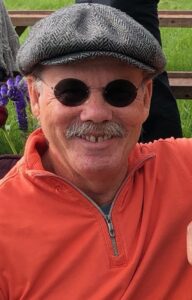
Max Mitchell, member of the Council’s Port Operations and Vessel Traffic System Committee, has been living in Homer for nearly five decades. He was born and raised nearly 5,000 miles away in an area known as “SOWEGA,” which is local-speak for the southwestern corner of the state of Georgia. Mitchell still has his Southern accent, but in everything else, his love of Alaska is readily apparent.
However, if not for a well-timed postcard, he would never have moved to Alaska.
Growing up, Mitchell moved around with his military family to Maine and North Carolina, then later on his own to Pennsylvania, but never found the right place to put down roots.
Mitchell knew he needed something different. Then, in the late 1970s, he got a postcard from a friend who was living in Hope. His friend had an inkling that Mitchell might like Alaska. So he packed up his Volkswagen Bus and hit the road.
“I had no idea what I was getting into,” Mitchell says of his journey north. “But it was a good thing for sure. I felt I was in the right place as soon as I got here.”
After some time in Hope, Mitchell landed in Homer, which has been his home base ever since. Mitchell got his first job unloading boats. Later on, he was hired to run a buy station, a water-front facility that purchases fish from vessels, for a cannery in Clam Gulch.
He enjoyed the work but noticed that everybody on the boats was having a lot more fun. “The next spring, I just pounded the docks ‘til I found a job,” he says. “Never looked back.”
He started with Dungeness crab. He says that the work of commercial fishing out of Homer was easier at the time. “That was right here in Kachemak Bay. When I got here, there were shrimp, there were all the species of crab.”
Mitchell worked all kinds of fisheries around the bay and into Cook Inlet, including king crab, salmon, and halibut.
“Gradually, all the fisheries just started moving out west.” Mitchell followed the fish out into the Gulf of Alaska, fishing for salmon, halibut, and his favorite fishery, black cod, also known as sablefish.
“They’re beautiful fish. We longlined, didn’t use pots in those days.” A longline is a line, up to a mile long, with baited hooks that lay on the seafloor to catch fish that live on or near the bottom of the water.
He had been fishing in Alaska for about 10 years when the Exxon Valdez ran aground. He was in Seattle on a layover, in the midst of traveling back to Georgia to help his mom make the move to Alaska. He wandered down to Pike Place Market and spotted the terrible headlines at a news stand.
“If I could, I would have just turned around and come back.”
When he returned, he got to work on a crabbing boat delivering fresh water to the responders cleaning the beaches.
After his daughter was born in the late 1990s, Mitchell was looking for more reliable work. In 2000, Crowley Maritime, who had just signed a contract to provide oil spill response services for Alyeska, was bringing powerful new escort tugs to Prince William Sound. He got a position as an able seaman and later as chief mate. He participated in a lot of drills, from practicing methods for towing tankers to oil spill response tactics.
When Edison Chouest Offshore took over Alyeska’s spill response contract in 2018, Mitchell retired from escort tug life. For a while, he worked on charters, taking scientists, film crews, bear watchers, and others out on the water. This past summer, though, the 80-year-old Mitchell decided to keep his feet on dry land.
“This is the first summer I haven’t a job on a boat,” he says. Mitchell recalls a recent conversation with his buddy Robert Archibald, fellow retired Crowley mariner and Council volunteer. “We realized we’ve spent half our lives floating.”
Mitchell’s decades of maritime experience in various roles means he has a lot to offer the Council’s Port Operations and Vessel Traffic System’s committee. The committee has been working with a researcher who is developing a program to improve communication between mariners from different cultures who speak different languages.
“That’s pretty important when there are foreign personnel on the bridge and they’re not really conversant in English,” Mitchell said.
Read more about the research and upcoming training program under development.