
A persistent challenge in environmental education and science communication is how to present a complex topic in an appropriate and efficient way for a specific audience. For example, how do we explain the Council’s Long-Term Environmental Monitoring Program, or LTEMP, to an audience that is a mix of Cordova students of many ages and adults?
LTEMP is a complicated project that measures hydrocarbons in the ocean environment of Prince William Sound. The work is rooted in the story of the Exxon Valdez oil spill and the need for baseline environmental data.
How do we communicate about this effectively in 10 minutes in an age-appropriate way? A best practice is to facilitate hands-on learning through an activity that addresses the topic. At the recent Ocean Sciences Festival in Cordova, the Council piloted a new activity to communicate one of the core elements of LTEMP: sampling mussels as an indicator species over many years.
The Festival, organized by the Prince William Sound Science Center, includes a variety of partner groups who host activity tables covering ocean topics such as marine science, industries, and careers. The latest event took place in November 2025.
In preparation, I worked with Dr. Danielle Verna, the Council’s Environmental Monitoring Project Manager, to develop an activity titled “Long-Term Mussel Monitoring.” In its short form, participants have the opportunity to examine and dissect blue mussels, make observations about and learn their anatomy, and think about why mussels are important to the ocean ecosystem. For example, blue mussels live abundantly in the intertidal zone consuming phytoplankton, or minuscule plant-like organisms. Mussels provide food for a variety of marine and land animals, and pass the nutrients from the phytoplankton up the food chain. The activity also invites participants to consider if they were going to observe mussels every year for 10 years, what research question or questions would they study?
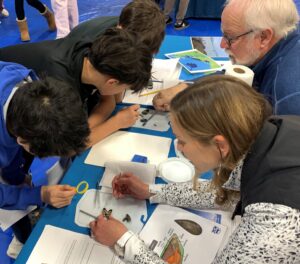
Danielle and our Cordova-based Board members David Janka and Robert Beedle tested out this activity with Festival attendees.
Younger students examined the mussel samples and made observations. In addition to dissecting the samples, older students and adults dove deeper by interpreting a graph that shows the 32 years of data, and a map of monitoring sites in the region. This allowed older participants to understand how blue mussels are useful as indicators of pollution in the environment.
Next steps for this new hand-on learning activity include creating a revised write up that will be available to educators on the Alaska Oil Spill Lesson Bank, the Council’s free lesson plan library. A longer version of this activity could dive further into the concept of an indicator species, which are an organism that reflects the state of an environment, such as the blue mussels are for the presence of hydrocarbon molecules in Prince William Sound in the LTEMP data set.
We were grateful to participate in this outreach event and try out this new activity engaging Cordova youth and community members in learning about the value of long-term environmental monitoring studies.