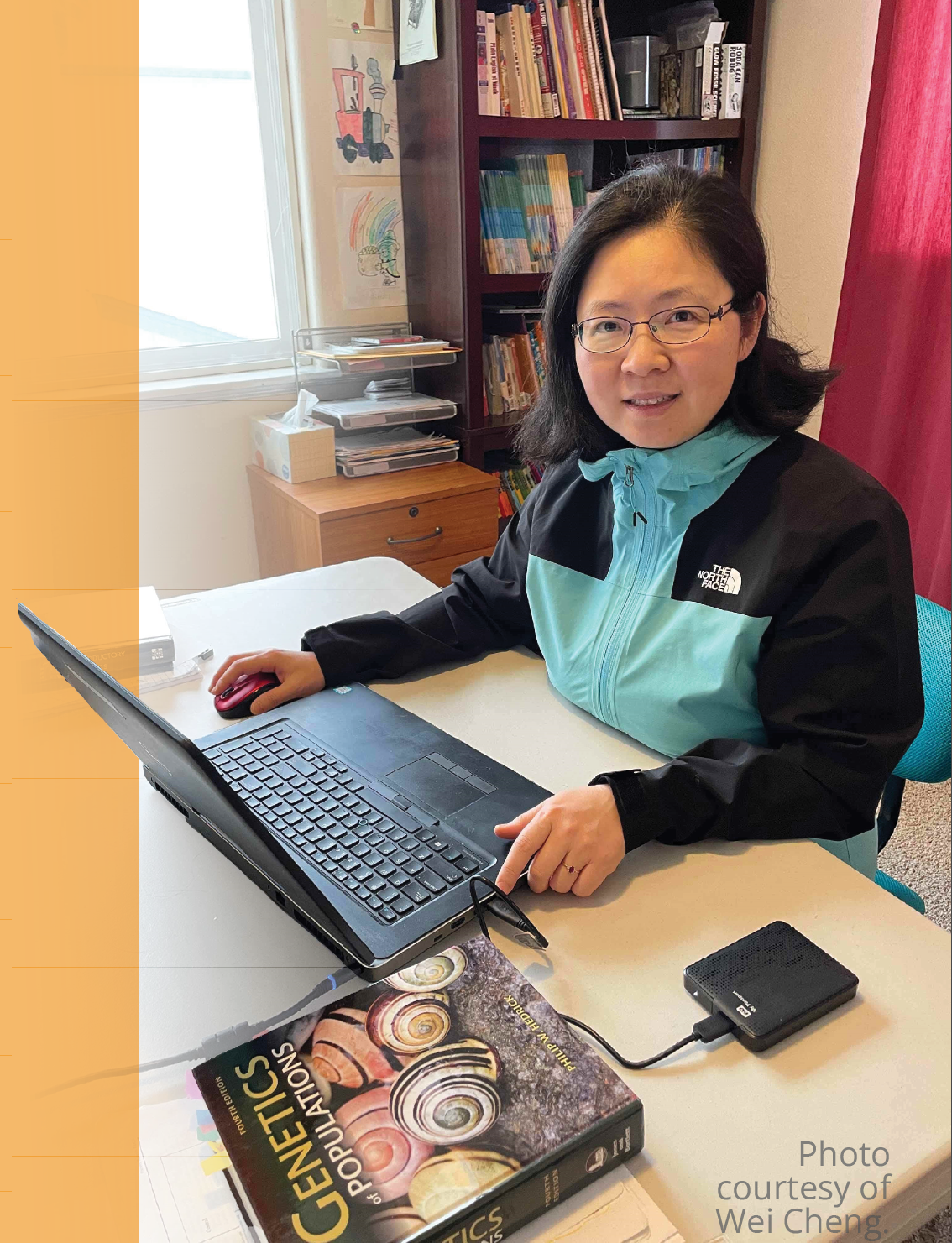
Volunteer Spotlight: Wei Cheng
Wei Cheng says she is happy and fortunate to be able to use her expertise in genetics to help protect Alaska’s salmon.
At her job with the Alaska Department of Fish and Game, or ADF&G, she analyzes genetic changes in fish to map the relationships among populations of salmon and other species of fish. The information she gains helps fisheries managers make decisions protect the integrity of wild populations of fish species.
Cheng is surprised at how much she enjoys the work. “To be honest, I was not interested in fisheries at all at the beginning,” she laughs.
Before coming to the United States from China, she graduated from medical school. Her area of interest was in human genetics and diseases, so she moved to Pittsburgh for graduate work in molecular biology at Duquesne University.
After graduation, her husband’s work brought them to Juneau.
“In Alaska we don’t have medical schools, pharmaceutical companies, or medical research labs,” Cheng says about her search for a job.
But she got lucky. The National Oceanic and Atmospheric Administration’s Auke Bay Laboratories reeled her in to help with studies using genetic analysis.
“That’s where I started working in fisheries.”
Cheng and her family eventually ended up in Anchorage, where she now works at ADF&G’s Gene Conservation Laboratory.
She has studied the population structure of pink salmon in Prince William Sound This study is the initial step to examine the interactions of wild and hatchery pink salmon in the area.
Salmon tend to spawn in the streams and rivers where they were born. But Cheng says sometimes they stray.