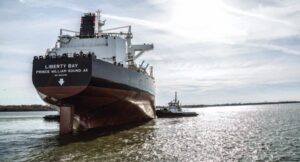
First of two new oil tankers to begin service in Prince William Sound in 2014

Photo of tanker Liberty Bay with escort tug. Photo courtesy of Aker Philadelphia Shipyard.
Photo of Liberty Bay courtesy of Aker Philadelphia Shipyard.

The first of two new SeaRiver oil tankers is expected to begin service in Prince William Sound later this year.

SeaRiver, the shipping arm of ExxonMobil, held a naming ceremony for the vessel Liberty Bay on April 25. The second vessel will be named Eagle Bay.

Built by Aker Philadelphia Shipyard, Inc., both vessels measure 823.5 feet long and 144 feet wide, and have double hull protection for both cargo and fuel tanks. The vessels are capable of carrying 115,000 tons of weight including cargo, fuel, ballast water, provisions and crew. Cargo capacity is 800,000 barrels (approximately 33.6 million gallons). Propelled by a slow speed diesel engine, the vessels’ “service speed” is 15 knots (approximately 17 miles per hour).

Ballast water treatment technology

Read more

Citizen network monitors for aquatic invasive species

With support from the council, a network of citizens monitor our region for invasive species, particularly European green crab and tunicates. This program was initiated by the council in 2000, and has evolved into a self-sustaining grassroots system. Many communities such as Homer and Seward now run their own operations through local science centers. The … Read more

Colder and saltier water increases toxic effects of dispersed oil

Temperature and salinity of water can have an effect on how toxic dispersed oil is to organisms in the environment, a council study has found. The Canadian Centre for Offshore Oil, the Bedford Institute of Oceanography and Department of Fisheries and Oceans conducted a council-sponsored study to look at the absorption of dispersed crude oil … Read more

Council studies effects of low level exposure to chemically dispersed crude oil on zooplankton

The long and short term effects of low level exposure to chemically dispersed crude oil on zooplankton needs more research, according to the council’s science committee. Studies have been conducted on the effects of high-level exposure to crude oil on large animals, such as sea otters and birds. However, not as much is known about … Read more

Skip to content