On April 12, a sheen was reported near the small boat harbor at the Valdez Marine Terminal. Investigations identified the source as a sump which overflowed. The primary causes of the spill have been identified as the failure of a check valve and a level indicator. The check valve became clogged with debris. A level … Read more
A new study evaluating methods of establishing tow lines between an escort tug and a tanker in distress is a prime example of why the Council’s studies are vital.
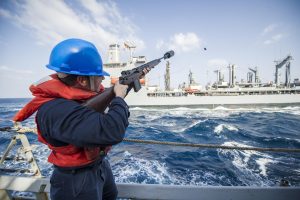
In this 2016 photo, a U.S. Coast Guard officer fires a messenger line from one military vessel to another. This is one method of connecting tow lines between a tug and a tanker. Photo by Pasquale Sena, U.S. Coast Guard.
The Council often hires experts to review equipment technology used in the Prince William Sound oil transportation industry. Sometimes these studies fill a hole or gap where independent research is lacking.
“Very little has been previously written on this topic,” said Alan Sorum, who managed this project and other similar technology reviews for the Council. “In a literature review it conducted, the Council’s contractor, Glosten, found that there is a general lack of published material on this subject and in particular, little guidance on best use practices or what is the most appropriate device to use for a given situation.”
By Betsi Oliver Outreach Coordinator After the Exxon Valdez oil spill, a Council project assessed the social impacts of the spill and developed resources that could be used by small communities to help with healing. An oil spill has complex and long-lasting impacts on the social and emotional health of a community, more than a … Read more
In March, the U.S. Environmental Protection Agency issued a temporary policy on how to handle enforcement and compliance during the COVID-19 pandemic. An April letter clarified that the policy was not intended to absolve companies of responsibility, but to allow flexibility for regulators to adapt to the unique situations presented by the pandemic.
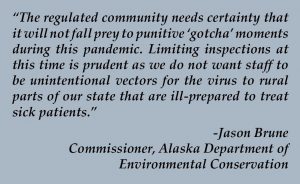
The EPA published remarks from public officials and stakeholders in support of the temporary policy, including remarks from Jason Brune, the commissioner of the Alaska Department of Environmental Conservation, or ADEC. The commissioner’s remarks are concerning, especially the reference to regulatory bodies, including ADEC and other state and federal agencies, seeking out “gotcha” moments in the course of their duty to enforce safety requirements.
In an April 24 letter to ADEC, the Council requested a commitment that all reasonable actions to prevent accidents from occurring would be taken. The Council also requested that any temporary policies such as this one be lifted as soon as the emergency declaration has ended.
Inspections are not ‘gotcha’ moments
The Council does not believe that regulatory oversight, including monitoring, inspecting, and reporting on industry operations, are punitive ‘gotcha’ moments. We also do not think that regulatory bodies seek to unnecessarily penalize industry during normal circumstances, let alone during an emergency such as the COVID-19 pandemic.