Walt Wrede is retiring after serving as the Council’s director of administration since 2016. Wrede’s passion for and knowledge of the political system in Alaska has been instrumental as he worked closely with the Legislative Affairs Committee to monitor developments on matters related to the Council’s mission in Washington, D.C., and Juneau. He also worked … Read more
The Council has released its annual report on drills and exercises conducted in Prince William Sound in 2021. This report highlights the continuing effects of the COVID-19 pandemic and lessons learned.
Reduced on-water monitoring for second year
For the second year in a row, the Council has been unable to monitor the on-water drills and exercises in Prince William Sound as closely as pre-pandemic years.
The Council has not been allowed on tugs or barges since early 2020, given COVID safety precautions. To be able to monitor some drills, the Council has chartered boats to observe from afar, but evaluation has proved difficult from such a distance.
“We can’t see the full evolution of the exercise or hear communications,” says Council drill monitor Roy Robertson. “We can’t tell if the crews are having problems deploying boom and we can’t time the activities like we usually do.”
By Danika Yeager Interim President, Alyeska Pipeline Service Company 2022 marks an exciting milestone; the 45th anniversary of the Trans Alaska Pipeline System, or TAPS. And in January, I stepped into the role as Alyeska president after Brigham McCown’s departure. I couldn’t be prouder to serve; I joined TAPS in April 2021, and it’s already been one … Read more
The Oil Pollution Act of 1990 notes congressional findings from the Exxon Valdez oil spill. Included in those findings was the need to foster the long-term partnership of industry, government, and local communities. This is a key piece of the foundation on which the Council was formed.
The Council may not always agree with industry and regulators, but we strive to maintain positive working relationships and build trust. While we do not hesitate to raise concerns when we perceive potential rollbacks in oil spill prevention and response safeguards, it is just as important to recognize when we are in agreement.
I am pleased to report the Council will be supporting Alyeska in a recent appeal they filed with the Environmental Protection Agency (EPA) (page 2). Our independent review verifies that systems Alyeska currently has in place at the Valdez Marine Terminal capture over 99% of the emissions addressed by the rule – a higher reduction goal than is currently being required. The Alaska Department of Environmental Conservation (ADEC) has also voiced support of Alyeska’s appeal to the EPA.
This collaborative approach goes both ways. For example, after months of coordination, Alyeska has also agreed to support a project proposed by the Council to look at the chemical composition and concentration of oxygenated hydrocarbons released from the terminal. Oxygenated hydrocarbons are less studied than other hydrocarbon products and they are potentially toxic in the aquatic environment. Revisions to the scope of work were necessary to satisfy Alyeska’s concerns, mostly related to COVID impacts and their desire to focus resources on their priority operational goals. This is another example of how good communication, strong relationships, and a willingness to work together can lead to solutions that support everyone’s goal of moving oil safely.
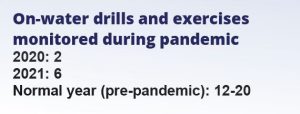 For the second year in a row, the Council has been unable to monitor the on-water drills and exercises in Prince William Sound as closely as pre-pandemic years.