Council updates position on dispersant use during an oil spill

Prevention and mechanical recovery should remain primary options The Council’s Board of Directors has updated the organization’s position on use of chemical dispersants in the event of an oil spill in the Prince William Sound and the Exxon Valdez oil spill region. The updated position states that dispersants should not be used on Alaska North … Read more

Board of Directors met in Seward

The Council’s Board of Directors met in Seward on September 22 and 23, 2022.  Final agenda (PDF) Meeting materials The Council conducted regular business during the meeting, including updates from Council ex officio members, staff and committees. Other topics included on the agenda were: An activity report by Alyeska Pipeline Service Company on the Valdez … Read more

Matt Cullin builds life of growth and success out of expertise in corrosion and failure analysis

Volunteer Spotlight

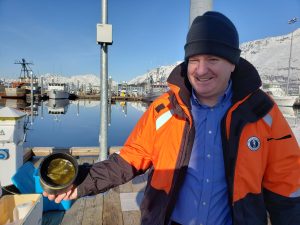
Cullin is a member of the Terminal Operations and Environmental Monitoring Committee. Volunteers like Cullin dedicate their time and expertise on committees who advise the Council’s Board of Directors on technical issues related to the safe transportation of oil through Prince William Sound.

At his job as the director of the University of Alaska Anchorage’s BP Asset Integrity and Corrosion Lab, Matt Cullin imagines himself as a detective.

“I do a lot of failure analysis work for the oil and gas industry,” he says. “Basically when stuff breaks, we do the CSI forensics to figure out why things broke and why they failed.”

They get big projects and a lot of smaller failures too. “Every couple of months somebody shows up with an old piece of pipe and asks us to tell them what happened.”

His goal isn’t just to solve the crime, though, he wants to learn how to prevent corrosion. For all of these projects, Cullin says his next question is always “how can you keep it from failing in the first place?”

Volunteering for the Council

Cullin also puts his background in mechanical engineering with a specialty in corrosion, materials, and failure analysis into use for the Council as a member of the Terminal Operations and Environmental Monitoring, or TOEM, Committee. He says working with the committee helps him better understand the pipeline and terminal. The students in his classes at UAA benefit too.

“Students have a lot of questions about the pipeline and the terminal,” Cullin says. “These are engineers who might go to work for the state or Alyeska and for them to have that information before they graduate is pretty neat. It’s not a given, when you get a university degree, that you’ll get to study this applied information that’s relevant to your local installation.”

“It’s a cool symbiotic relationship,” he adds.

Read more

Skip to content