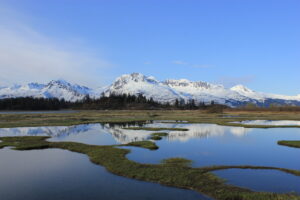
Researchers find new non-native species in Prince William Sound

Last year, researchers from the Smithsonian Environmental Research Center, or SERC, partnered with the Council to conduct the largest survey of non-native benthic marine invertebrate species in Prince William Sound since 2003.

The work is part of a larger survey being conducted by Dr. Gregory Ruiz and a team of researchers from SERC to document non-native species in ports and bays throughout the United States. The researchers have also recently surveyed in California, southeast Alaska, and other sites along the Pacific coast of the U.S. Researchers anticipate surveying Cook Inlet in 2025.

Gulf-Alaska Knowledge Exchange – Resources from PWSRCAC

The following list contains links to various PWSRCAC information and resources that were mentioned during the National Academies Workshop 1: Gulf-Alaska Knowledge Exchange: Evaluating Socio-economic Impacts of Oil Spills, Advancing Transformative Recovery, and Enhancing Proactive Preparedness.

Please contact Amanda Johnson if you’d like more information about the Council or any of the resources below.


About the Prince William Sound Regional Citizens’ Advisory Council (PWSRCAC)

  1. Involving citizens: The 1989 Exxon Valdez experience demonstrated that the oil industry could learn from people who live and work in the region affected by the terminal and tanker operations. A moral imperative also emerged from the Exxon Valdez spill: those people with the most to lose from oil pollution must have a voice in the decisions that put their livelihoods and communities at risk.
    • The Council’s 20 Board members represent 19 member entities. The member entities are Alaska communities and organizations that were affected by the Exxon Valdez oil spill, including aquaculture, commercial fishing, environmental groups, Alaska Native communities, recreation, and tourism. Board members are volunteers who are nominated by the member entity to serve two-year terms.
    • The Council has five technical committees made up of volunteers who focus on various aspects of the oil transportation industry in Prince William Sound.
    • Effectiveness Of Citizen Involvement – A 2006 white paper by Linda Robinson summarizing how the Council came to be, our responsibilities, and our programs and committees. “We were formed in a climate of adversity, but we have learned that working together in partnership is better and more productive and that it is important to give praise as well as criticism.” – Linda Robinson, 2006. See also: History of the Council
  2. Funding
    • Contract with Alyeska – This contract guarantees annual funding for the Council and ensures absolute independence from Alyeska (the consortium of oil industry companies who owns the Trans Alaska Pipeline and oil terminal in Valdez). The contract is in effect as long as oil flows through the pipeline.
    • Oil Pollution Act of 1990 (OPA 90) – Through OPA 90, Congress mandated citizens’ councils for Prince William Sound and Cook Inlet as a method to combat complacency.

Read more

Whittier community engages with on-water oil spill response training

The Prince William Sound Regional Citizens’ Advisory Council held a tour for locals to observe the annual oil spill response training for fishing vessels in Whittier, Alaska, on Sept. 30, 2024. This has been an annual event since 2016, rotating through several communities in the region, though it was postponed during the height of the … Read more

Kodiak meeting and events, September 18-20

The Council held three events in Kodiak on Wednesday through Friday, September 18-20, 2024, including the Council’s annual board meeting, a youth education event and a public reception. Final agenda All meeting documents and video/teleconference information On the agenda The Council conducted regular business during the meeting, including updates from Council ex officio members, staff … Read more

Skip to content