New Board member for Chugach Alaska

At the January meeting, the Council’s Board of Directors seated a new member, Ben Cutrell, as the representative for Chugach Alaska Corporation. Cutrell was born and raised in Wasilla, Alaska. He moved to Anchorage to pursue a Bachelor’s of Natural Science and Biology from the University of Alaska Anchorage. Upon completion of his degree, he … Read more

Transparency is the foundation of public trust

By Donna Schantz
Executive Director

Public trust in our oil spill prevention and response system took many years to rebuild after the 1989 Exxon Valdez oil spill. It took a commitment to transparency, listening, and engaging stakeholders in developing and maintaining the system of safeguards for the Valdez Marine Terminal and associated tankers that we have today.
Photo of Donna Schantz
Donna Schantz

This system is now widely regarded as one of the best in the world. Strong State of Alaska statutes and regulations have supported this robust system. The lack of significant spills in Prince William Sound over the last 30 years indicates the effectiveness of industry meeting or exceeding regulatory requirements.

Trust in the system is at risk

Over the past few years, the Council has been seeing a steady erosion in regulatory oversight, staffing, funding, and coordination among many of the federal and state agencies responsible for enforcing strong laws and regulations. This alarming erosion has already started to reduce public trust in our prevention and response system.

In enacting the Oil Pollution Act of 1990, Congress determined that only when local citizens are involved in oil transport will the trust develop that is necessary to change the system from confrontation to consensus, and so the Act called for creation of citizen councils. Our Council is a unique partner for industry and regulators, giving them a platform to provide information, answer questions, listen to stakeholders, and cultivate the long-term relationships that are necessary to establish public trust.
Read more

Shares of pipeline and terminal expected to change hands this year

Lack of public information about BP to Hilcorp sale leads to concerns

Late last year, Hilcorp Energy Company announced that they intend to purchase all of BP’s Alaska-related assets. These assets include approximately 49% interest of the Trans Alaska Pipeline System and Alyeska Pipeline Service Company.

Assuming the deal goes through, Hilcorp will take over BP’s facilities on Alaska’s North Slope and their affiliate Harvest Alaska LLC will take over BP’s share of the pipeline and terminal. Harvest’s specialty is “midstream” operations, which means moving oil from the production site to a destination such as a refinery or shipping terminal.

Harvest representatives have stated that their company has grown mostly through acquiring existing facilities and operating them through the end of the facility’s life. They have said that their experience with issues that occur in aging facilities, such as corrosion, would be a benefit for the pipeline and terminal, which is now over 40 years old.

Read more

Alaska’s oil spill laws and regulations opened for public review

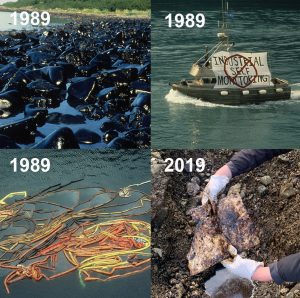
Collage of four images showing Exxon Valdez oil from 1989, tangled oil spill boom from 1989, and a protesting fishing vessel, along with a 2019 photo of lingering oil in Prince William Sound.
This photo collage shows three scenes from the Exxon Valdez oil spill and one of Exxon Valdez oil in Prince William Sound in 2019.

The Alaska Department of Environmental Conservation recently began a process to review and potentially change oil spill laws and regulations in Alaska. The department’s first step, a public scoping, opened on October 15, 2019.

The department is currently asking for input from stakeholders, the public, and industry on areas where Alaska’s oil discharge prevention and response contingency plan laws and regulations could be streamlined. In the department’s official announcement for this review process, Commissioner Jason Brune stated that “I’ve heard from many Alaskans that contingency plans are unnecessarily burdensome while lacking corresponding environmental benefits. To achieve Governor Dunleavy’s goal of being open for business, today we are beginning a fully transparent scoping process seeking the public’s input.”

Read more

Skip to content