Colin Daugherty’s accent quickly gives him away as a native Chicagoan.
“It’s unlikely that I ended up here in Alaska, working on boats,” says Daugherty, a recent addition to the council’s Oil Spill Prevention and Response Committee. “I grew up in inner city Chicago. There was a program there that taught kids about boating skills and seamanship. I was part of that growing up, and it kept me out of trouble.”
Daugherty has been on and around boats ever since.
After school, he moved to St. Croix in the U.S. Virgin Islands, where he first got involved with spill prevention and response. He was hired at the Hovensa refinery, at the time the largest fuel refinery in the western hemisphere.
“I felt good about what we could do if bad things happen.”
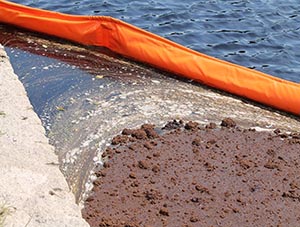
A group of oil spill preparedness planners in Prince William Sound are working together to develop an improved method of training for oil spills. The council has been working for many years to find a suitable oil “surrogate” for spill response training. Surrogates are floating substances such as wood chips, peat moss, or other materials that would mimic an oil slick and have similar interactions with currents, tides, and winds, without harming the environment. A surrogate would provide a target for responders during training and exercises; something which physically interacts with boom and equipment and acts as a visual aid to help responders increase proficiency with gear and tactics.
Federal policies do not provide guidance for surrogates. Instead, local solutions are encouraged which can be tailored to fit each region’s particular environmental concerns.
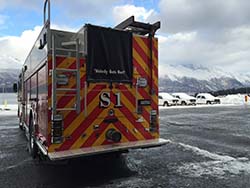
Alyeska’s new fire and rescue engine, known as “Squad 1,” is at the terminal and ready for action. Photo courtesy of Alyeska.
In December, Alyeska Pipeline Service Company and the City of Valdez agreed to a plan for the Alyeska Fire Brigade and the Valdez Fire Department to work together to fight fires. This agreement defines the roles, relationships, jurisdiction, and responsibilities of the two parties in advance of an emergency. The agreement provides the framework for a coordinated emergency response within Valdez city limits.
The council supports the agreement as it will improve the ability of Alyeska Fire Brigade and the Valdez Fire Department to work in coordination both on and off Valdez Marine Terminal property. The agreement will help limit the possible loss of life and property in the event of an emergency, and decrease the potential environmental impacts of a fire at the terminal.
The agreement says that the Alyeska Fire Brigade may assist the Valdez Fire Department during an emergency within the city limits but off of Alyeska property. While not required to do so, Alyeska may provide emergency assistance to the City of Valdez, if a number of conditions are met. Foremost, their service must be specifically requested by the Valdez Fire Department and Alyeska must be able to maintain their minimum required fire and rescue staffing levels at the terminal even while assisting the City of Valdez. Alyeska will not charge the city for emergency services under this agreement.
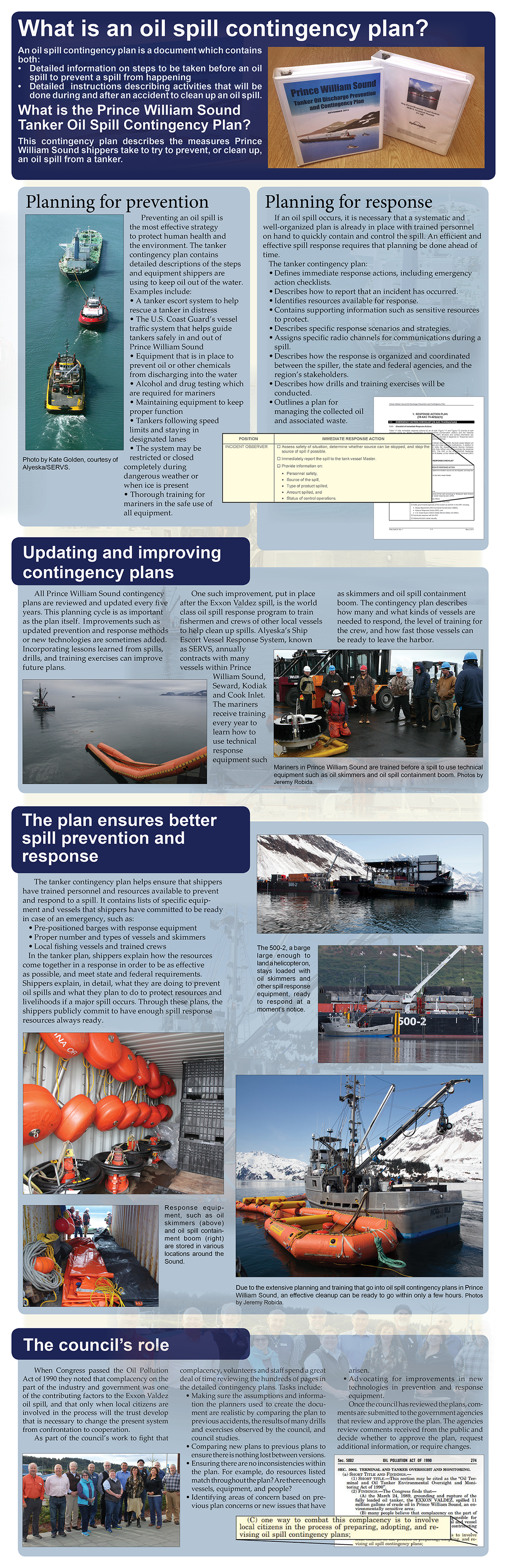
An oil spill contingency plan is a document which contains both:
Detailed information on steps to be taken before an oil spill to prevent a spill from happening
Detailed instructions describing activities that will be done during and after an accident to clean up an oil spill.
What is the Prince William Sound Tanker Oil Spill Contingency Plan?
This contingency plan describes the measures Prince William Sound shippers take to try to prevent, or clean up, an oil spill from a tanker.
Planning for prevention
Preventing an oil spill is the most effective strategy to protect human health and the environment. The tanker contingency plan contains detailed descriptions of the steps and equipment shippers are using to keep oil out of the water. Examples include:
A tanker escort system to help rescue a tanker in distress
The U.S. Coast Guard’s vessel traffic system that helps guide tankers safely in and out of Prince William Sound
Equipment that is in place to prevent oil or other chemicals from discharging into the water
Alcohol and drug testing which are required for mariners
Maintaining equipment to keep proper function
Tankers following speed limits and staying in designated lanes
The system may be restricted or closed completely during dangerous weather or when ice is present
Thorough training for mariners in the safe use of all equipment.
 Colin Daugherty’s accent quickly gives him away as a native Chicagoan.
 A group of oil spill preparedness planners in Prince William Sound are working together to develop an improved method of training for oil spills. The council has been working for many years to find a suitable oil “surrogate” for spill response training. Surrogates are floating substances such as wood chips, peat moss, or other materials that would mimic an oil slick and have similar interactions with currents, tides, and winds, without harming the environment. A surrogate would provide a target for responders during training and exercises; something which physically interacts with boom and equipment and acts as a visual aid to help responders increase proficiency with gear and tactics.