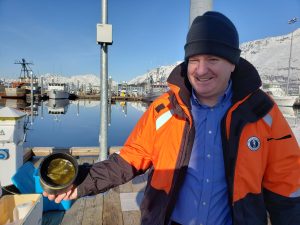
Plankton change with the seasons in Prince William Sound

In this photo, a Council staff member holds a sample, which is green due to the tiny plants, or phytoplankton, in the sample.
Staff member Joe Lally holds a sample collected during the spring phytoplankton bloom.

A new Council study will help improve monitoring for invasive species, such as tunicates, that live on the sea floor or hard surfaces.

Researchers collected samples of zooplankton and used an identification technique called DNA metabarcoding. This technique allows researchers to identify multiple species from the same sample.

Read more

Council updates position on dispersant use during an oil spill

Prevention and mechanical recovery should remain primary options The Council’s Board of Directors has updated the organization’s position on use of chemical dispersants in the event of an oil spill in the Prince William Sound and the Exxon Valdez oil spill region. The updated position states that dispersants should not be used on Alaska North … Read more

Council supports Alyeska’s appeal to EPA

In late 2020, Alyeska Pipeline Service Company appealed a July 2020 Environmental Protection Agency air quality rule that would regulate emissions from the crude oil storage tanks at the Valdez Marine Terminal. Alyeska asserted that the new rule would not result in emissions reductions at the terminal, that local residents would not see air quality … Read more

Prince William Sound is home to a variety of bird species in winter

Frigid Alaska winters can be a tough time and place for wildlife. Food is scarce, the climate can be extreme, and days are short. Many species of birds head south.

However, some hardier species, such as marbled murrelets, common murres, pelagic cormorants, black-legged kittiwakes, and glaucous-winged gulls tough it out over the winter.

Read more

Skip to content