Foreign tankers arrive in Prince William Sound

Council observing process
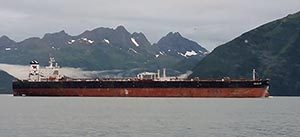
The 900-foot long Tianlong Spirit was built in 2009 and is registered in the Bahamas. Photo by Doug Craig.

Two foreign-flagged tankers hauled Alaska North Slope crude oil from the Valdez terminal this summer for the first time in over 30 years. The last time non-U.S. vessels shipped Alaska crude to foreign refineries was in the 1980s when West Coast refineries could not keep up with the amount of crude coming out of the pipeline.

The first tanker, the Tianlong Spirit, visited the terminal late last July and the second, the Cascade Spirit, arrived in early August. Both are chartered by BP, and owned by Teekay Corporation.

A ban on selling U.S. oil was put in place during the 1970s Arab oil embargo in an effort to keep Alaskan oil in the U.S. At the time, the U.S. was in the middle of an energy crisis and gasoline prices were soaring. Alaska oil was exempted from the ban in 1995 under President Clinton, although the oil still had to be transported by U.S.-flagged tankers. Congress lifted the export ban for the rest of the U.S. in late 2015, which the Alaska delegation sought for the past 20 years. This change also allowed foreign tankers to transport oil out of the U.S.


Read more

From the President and Executive Director: Partnerships build trust and help prevent oil spills

By Amanda Bauer, President of the Council’s Board of Directors and Donna Schantz, Executive Director.

Amanda Bauer
Donna Schantz

In 1990, just after the worst oil spill the U.S. had ever seen, Congress was tasked with creating legislation that would prevent such a disaster from happening again. One goal of the resulting legislation, the Oil Pollution Act of 1990, was to foster long-term partnership and build trust between industry, government, and local communities. To help accomplish this, the Act mandated regional citizens’ advisory councils to help monitor the oil industry in Prince William Sound and Cook Inlet.

Great visionaries began this experiment in building partnership and trust. While some of these people are no longer with us, we still share the vision that motivated them.

Today, the council still works to find common ground between citizens, the oil industry, and regulators in order to develop the trust necessary to build and maintain the safest marine transportation system in the world.

Read more

Marine services for Alyeska to change hands in 2018

The tug Tanerliq tethered to the tanker Overseas Washington in 2002.
The tug Tanerliq tethered to the tanker Overseas Washington in 2002. Photo by Stan Jones.

Update: This article ran in the May issue of our newsletter, The Observer, stay tuned for updates in the next issue!


Crowley Marine Services, the contractor who provides oil spill prevention and response services to Alyeska Pipeline Service Company, will no longer provide those services after June 30, 2018.

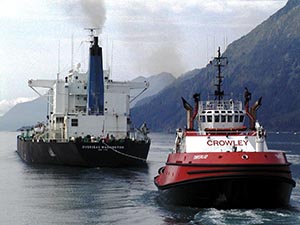
Crowley has held this contract with Alyeska since the company created its Ship Escort/Response Vessel System, also known as SERVS, after the Exxon Valdez oil spill. Crowley also provided tanker docking services since 1977, and helped dock the first tanker at the Valdez terminal.

Crowley owns the powerful tugboats that escort loaded oil tankers through Prince William Sound. The tugs also scout for ice drifting from nearby Columbia Glacier, and are equipped to start cleaning up a spill or tow a disabled tanker if needed. In addition to the escort tugs, Crowley owns response tugs that help the tankers dock and other support vessels and barges stationed in Prince William Sound which contain Alyeska’s boom, skimmers, and other equipment for a quick response to an oil spill.

Crowley employs 230 mariners and 17 administrative personnel in the area.

Read more

Researchers say ice drifting into tanker lanes will be smaller but more numerous in future

By Alan Sorum
Council Project Manager

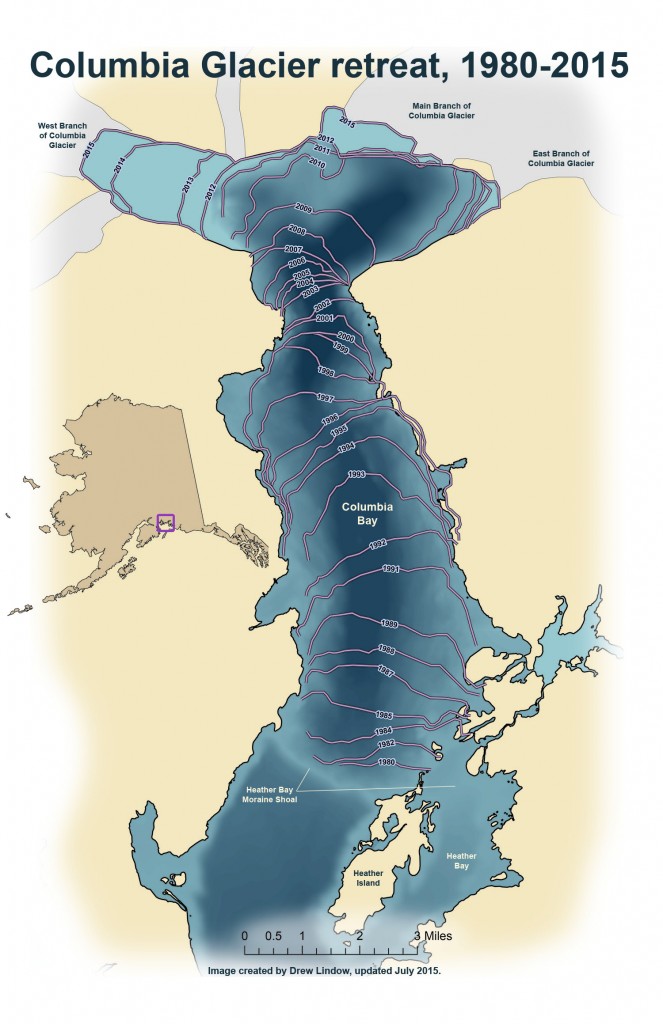
Columbia Glacier Retreat, 1980-2015
Click map for larger image.

Columbia Glacier, located in the Chugach Mountains of Alaska, is losing mass faster than almost any other glacier in the state. Columbia is a tidewater glacier, a type of valley glacier that flows into the ocean.

In 1996, the council began a project to monitor and analyze the calving and drift of ice from the glacier, through Columbia Bay, and into Prince William Sound. The ice sometimes drifts into the established tanker shipping lanes. Loaded tankers leave their designated lanes to avoid this ice.

In 2012, the council began to update information developed in the original 1996 project to determine the future risk of Columbia Glacier icebergs to the tanker traffic. Funded by the council, researchers W. Tad Pfeffer and Shad O’Neel studied several aspects of ice loss at Columbia Glacier.

The study found that icebergs discharged by the glacier during the retreat have largely been contained within the moraine shoal, located at the position of the terminus prior to the glacier’s retreat. The fraction of icebergs that cross the moraine and enter Prince William Sound proper still pose a potential hazard to ship traffic in the Sound.

Read more

Skip to content