Update on COVID-19 impacts on Council activities The Prince William Sound Regional Citizens’ Advisory Council is scheduled to hold a Board meeting on Thursday and Friday, May 7-8, 2020. Today the decision was made by the Board to hold the meeting through virtual attendance only, by video/teleconference. The meeting schedule and agenda will be released … Read more
The U.S. Coast Guard has recertified the Council as meeting its responsibilities under the Oil Pollution Act of 1990. In a February 25 letter to the Council, Rear Admiral M. T. Bell, Commander of the Coast Guard’s District 17 in Juneau, notified the Council of recertification. The Act requires the Council to be recertified annually … Read more
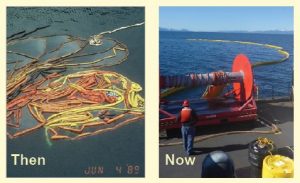
The Exxon Valdez oil spill taught many lessons about oil spill prevention and preparedness, such as ensuring responders are better trained ahead of time to use cleanup equipment. The strong rules that resulted from that spill mean better preparedness today.
Yesterday the Council submitted comments on the Alaska Department of Environmental Conservation’s public scoping on the state’s oil spill contingency plans for preventing and cleaning up an oil spill.
“PWSRCAC does not think the regulations are necessarily flawed as they are written. The regulations have proven to be protective of Alaska’s people and environment for decades, and it is critical that the protections written into them not be weakened in any way. It is equally important to maintain transparency, predictability, and specificity required to verify operational needs, which is currently in the regulations.”
Public trust in our oil spill prevention and response system took many years to rebuild after the 1989 Exxon Valdez oil spill. It took a commitment to transparency, listening and engaging stakeholders in developing and maintaining the system of safeguards we have today for the Valdez Marine Terminal and associated tankers. Alyeska Pipeline Service Company initiated many of the spill prevention and response improvements by working with regulators and the public, a testament to their ongoing commitment to the people, environment and safety.
Donna Schantz
This system is now widely regarded as one of the best in the world. Strong State of Alaska statutes and regulations have been a major driver of this robust system. The lack of significant spills in Prince William Sound over the last 30 years indicates the effectiveness of industry meeting or exceeding regulatory requirements.
In enacting the Oil Pollution Act of 1990, Congress determined that only when local citizens are involved in oil transport will the trust develop that is necessary to change the system from confrontation to consensus, and so the Act called for creation of citizen councils.
The Prince William Sound Regional Citizens’ Advisory Council was created to provide a voice for citizens, those with the most to lose in the event of a large spill. Our council is a unique partner for industry and regulators, giving them a platform to provide information, answer questions, listen to stakeholders and cultivate the long-term relationships that are necessary to establish public trust. Involving local citizens in the process of independently verifying the state of readiness to prevent and respond to oil spills helps build trust.