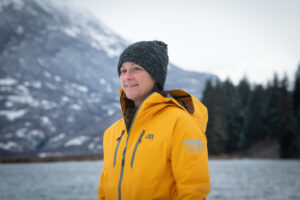
Dr. Amanda Glazier, scientist and educator, is the newest member of the Council’s Information and Education Committee. She grew up in Connecticut, but credits a family trip to St. John in the U.S. Virgin Islands for the beginnings of her fascination with marine biology.
“I was in maybe 3rd grade, and the place we stayed had a little reef, right off the beach,” Glazier recalls. “It was kind of like our little personal reef.”
Topics that capture a child’s attention often change over time, but Glazier never lost this early interest. In college, she studied marine biology at the University of Maryland College Park, earning an Honors citation, eventually going on to earn a Ph.D. from University of Massachusetts Boston.
Glazier worked as a researcher for several years, including participating in deep-sea research cruises in the Gulf of Mexico and Costa Rica. Her research included investigating the transcriptomic response of deep-sea corals to the oil and dispersant from the BP Deepwater Horizon disaster.
Transcriptomics involves measuring how particular genes are expressed in an organism. This expression can be affected by conditions in the environment.
Building new opportunities for students in the Prince William Sound
In 2021, Glazier moved from Philadelphia to Alaska, joining the Prince William Sound College in Valdez as an Assistant Professor of Environmental Science and Biology.
“There was no program before I got here,” she says. “It was a little bit scary, but also fun and exciting, because there was a lot of flexibility to build it in the way I wanted to.”
She runs two intensive natural resources programs. One focuses on land-based topics, such as forestry, and the other focuses on marine-based topics, such as mariculture. Students completing the program build skills that qualify them for technician-level positions.
“Both of the programs are experiential learning in the field, as much as we can,” Glazier says. “The students can leave those programs and get a summer research tech job, work as a seasonal employee with the Park Service, or continue on to an associate’s or bachelor’s.”
Developing a research program with funding from the Council’s Youth Involvement Program
In 2023, Glazier added another new program that gives undergraduate students an opportunity to design and complete their own independent research project (YouTube). The students, with Glazier’s oversight, start with an idea, create a study protocol, complete the project, and present their findings.
The program’s first year was partially funded by the Council’s Youth Involvement program, an initiative of the Information and Education Committee. Through this program, educators can apply to receive up to $5,000 for teaching projects related to the Council’s mission.
“$5,000 is a good, manageable size,” Glazier says. “You can run a short-term class, or an activity within a class. It’s not so big that it doesn’t make sense to apply for it, and it’s not so small that you can only get, like, 3 pencils.”
She no longer receives funding from the Council, because her program took off and now receives funds from a variety of grants.
The students gain experience that would not otherwise be possible. Glazier says that in many research programs at other colleges the topic is assigned according to the faculty member’s area of research.
“The way that my funding works, it’s whatever the students want to do. So, we have projects all over the place,” she says. “Usually they gear towards marine biology, but we’ve also had one on science communication, a social science project, a project about law, invasive deer, a GIS project. It’s interesting.”
Glazier’s students present their projects at an annual research symposium at the college. This May was the symposium’s fourth year.
“We had a lot more student posters than we had in the beginning,” Glazier says.
“This past year, three of the research students focused on an invasive slug.” The slug is a recent invader into the Valdez area. The students focused on different aspects, including genetics, ecology, and a scientific illustration poster that incorporated Alaska Native cultural arts.
“That flexibility in their projects makes it that much more interesting.”